

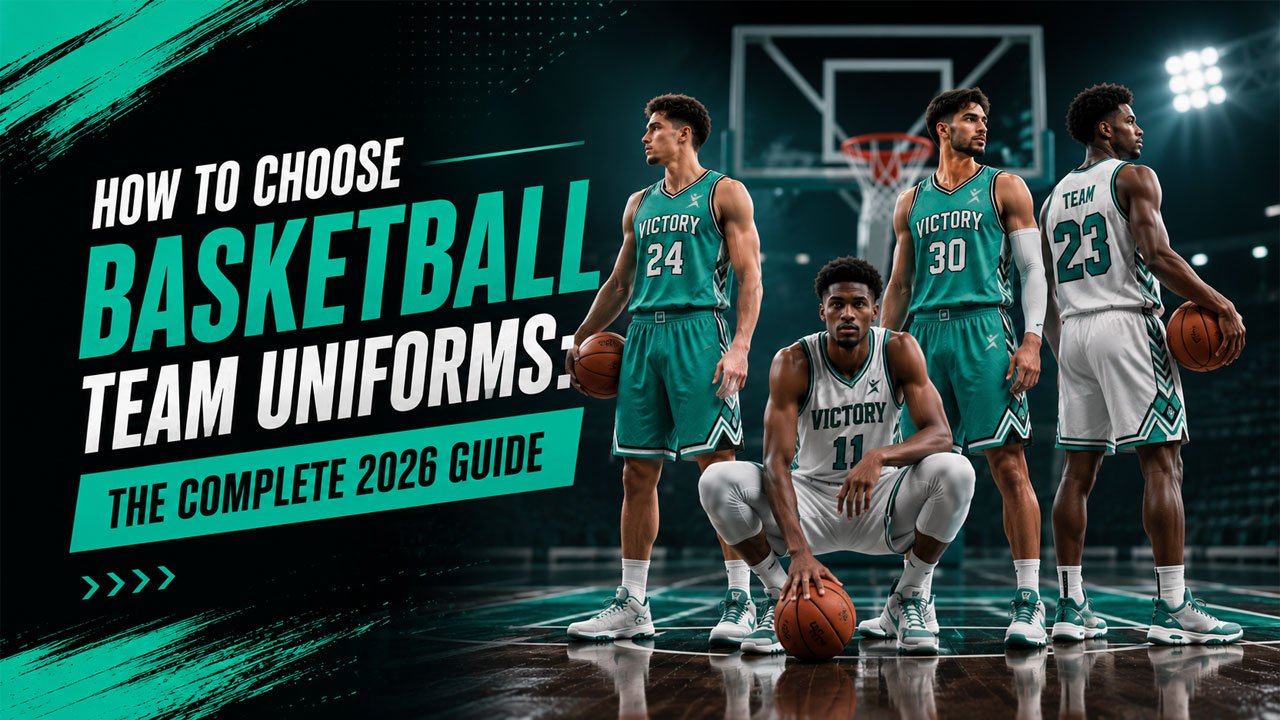
Learn how to choose basketball team uniforms with the right fit, fabric, design, sizing, customization, durability, and budget for your team.
How to Choose Basketball Team Uniforms: The Complete 2026 Guide
Learn how to choose basketball team uniforms with the right fit, fabric, design, sizing, customization, durability, and budget for your team.
Choosing the right basketball team uniforms is more than picking a jersey color and adding a logo. A good uniform needs to look professional, feel comfortable during intense games, allow players to move freely, make names and numbers easy to recognize, and withstand repeated use throughout the season.
Whether you are a coach, athletic director, school administrator, club manager, tournament organizer, or team owner, the wrong uniform choice can create unnecessary problems. Poor sizing can leave players uncomfortable. Low-quality fabric can become unpleasant during long games. Weak color contrast can make numbers difficult to read. And rushing an order can leave your team without uniforms when the season begins.
The good news is that choosing basketball team uniforms becomes much easier once you know exactly what to evaluate. This guide from Noxico International walks through fit, fabric, jersey styles, colors, numbers, customization, printing methods, sizing, durability, budget, ordering, and the mistakes to avoid.

Quick Answer: How Do You Choose Basketball Team Uniforms?
To choose the right basketball team uniforms, evaluate these factors in order:
- Determine your team’s needs and playing level.
- Choose the right jersey and shorts style.
- Select a comfortable, breathable fabric.
- Decide between a relaxed or athletic fit.
- Build a clear team color system.
- Choose readable numbers and typography.
- Select the right customization and printing method.
- Design the jersey and shorts as one uniform.
- Check league or tournament requirements.
- Confirm every player’s measurements and sizes.
- Compare manufacturers based on quality, service, and price.
- Review the final proof before production.
- Order early enough to handle production and shipping.
- Confirm whether replacements and future reorders are possible.
The best basketball team uniform balances performance, comfort, appearance, durability, team identity, and total cost.
Why Choosing the Right Uniform Matters
A basketball uniform is part of the team’s identity, but it also has a practical job. Players spend an entire game running, jumping, cutting, defending, rebounding, and shooting, and their uniforms should support those movements rather than become a distraction. The right uniform can provide better freedom of movement, improved comfort, breathability, clear player identification, a consistent team appearance, stronger team identity, better durability, and more confidence on the court. That is why the decision should not be based on appearance alone.
Determine What Your Team Actually Needs
Before looking at designs, colors, or manufacturers, define the requirements of your team. A youth recreational team will not necessarily need the same uniform as a competitive AAU program, high school varsity team, college club, or adult league.
Start by answering these questions:
- How many players are on the roster?
- What age group are they?
- What level of basketball do they play?
- How frequently will the uniforms be used?
- Will the team play tournaments?
- Do you need home and away uniforms?
- Do you need reversible jerseys?
- Will you need matching shorts, warm-up apparel, or replacement uniforms later?
A recreational team playing a few games may prioritize affordability, while a competitive team playing several tournaments may place greater importance on fabric performance, durability, and consistent reordering. Start with the use case, not the design.
Choose the Right Basketball Jersey Style
Basketball uniforms come in different styles, and the right option depends on your team’s preferences and requirements.
Sleeveless Basketball Jerseys
The traditional sleeveless basketball jersey remains popular because it provides a familiar basketball appearance and leaves the arms unrestricted. It can be a good choice for teams that prioritize maximum arm movement, traditional basketball styling, breathability, and a classic team appearance.
Short-Sleeve Basketball Jerseys
Short-sleeve designs offer a more modern appearance and provide additional space for graphics. They may appeal to teams looking for a contemporary sportswear aesthetic, though movement and comfort should still be the most important consideration.
Reversible Basketball Jerseys
Reversible uniforms provide two color schemes in one garment. They can be useful for recreational leagues, practice sessions, teams with limited budgets, and programs that need light and dark options. The trade-off is that reversible construction can affect the weight, fit, and available design space. Choose based on your team’s actual needs rather than simply choosing the most fashionable style.

Choose the Right Basketball Uniform Fabric
Fabric is one of the most important decisions you will make. Basketball is a high-intensity sport, and players generate heat quickly, especially during tournaments, long games, and repeated sessions. A good basketball uniform fabric should ideally be lightweight, breathable, comfortable, moisture-managing, flexible, durable, and easy to maintain. Common performance options include polyester-based fabrics, mesh constructions, and polyester blends, sometimes with added stretch materials for flexibility.
Why Breathability Matters
A uniform that traps heat can quickly become uncomfortable. Breathable construction allows air to move through the garment and can help players remain more comfortable during intense activity.
Why Moisture Management Matters
Players sweat during basketball games. A suitable performance fabric can help manage moisture and keep the garment more comfortable than heavier everyday clothing.
Why Durability Matters
A uniform may be worn repeatedly and washed frequently. Look beyond how the fabric feels when it is brand new — consider how it will perform after multiple games, frequent washing, tournament weekends, regular transportation, and an entire season. The best value is not necessarily the cheapest uniform; it is the uniform that performs well for the amount of use your team expects.

Choose the Right Uniform Fit
Fit can have a major impact on how players feel during a game. A basketball uniform should allow players to raise their arms, shoot, run, jump, defend, turn quickly, bend, and change direction without feeling restricted.
Relaxed Fit
A relaxed fit provides additional room and offers a traditional basketball appearance. It may work particularly well for teams that prefer a classic style or need additional room for younger players.
Athletic Fit
An athletic fit provides a more streamlined appearance while still allowing sufficient movement. It can appeal to high school, club, AAU, and competitive teams looking for a modern look.
There is no universal “best” fit — the correct choice depends on the age group, body types, playing level, and team preference.
Get Basketball Uniform Sizing Right
Sizing is one of the easiest places to make an expensive mistake. Never assume that a player’s normal T-shirt size will automatically match a manufacturer’s basketball uniform size, since different manufacturers can use different measurements and cuts.
Instead:
- Get the manufacturer’s official size chart.
- Measure players accurately.
- Record jersey and shorts sizes separately when necessary.
- Review the complete roster.
- Confirm unusual sizes with the player or parent.
- Request samples when available.
A useful team sizing sheet should include the player’s name, jersey size, shorts size, and number — for example, Player 1 (Medium/Medium/#10/Smith), Player 2 (Large/Large/#23/Johnson), and so on down the roster. For youth teams, growth should also be considered, though ordering significantly oversized uniforms can negatively affect comfort and appearance. Some suppliers provide sample kits, which can make the sizing process much safer before a bulk order.
Build a Strong Team Color Palette
Color is one of the most recognizable parts of a basketball uniform. Start with your team’s existing identity — school colors, club colors, a logo, a mascot, brand colors, or sponsor colors.
A simple color system is often easier to use consistently. A useful approach is: primary color + secondary color + accent color — for example navy + white + gold, black + red + white, royal blue + white + silver, or forest green + cream + black. Using too many colors can make the uniform look crowded. A controlled palette also makes it easier to create matching jerseys, shorts, warm-ups, shooting shirts, hoodies, bags, and fan apparel.
Some current basketball design directions include gradients, asymmetric panels, heritage typography, muted palettes, and full-sublimation patterns — but trends should support your team’s identity rather than replace it.
Make Numbers Easy to Read and Choose the Right Font
A basketball jersey number has an important functional purpose. Players need to be identified quickly by coaches, referees, opponents, scorekeepers, and spectators, which means readability should come before decoration. Choose numbers with strong contrast, clear shapes, appropriate size, consistent placement, and easy-to-read typography. Avoid placing numbers over complicated graphics that make individual digits difficult to recognize.
The test is simple: can someone identify the number quickly from a distance? If not, simplify the design.
Typography also affects the personality of a uniform. A traditional block font can communicate a classic athletic identity, a modern condensed font can create a contemporary appearance, and a vintage or collegiate style can provide a heritage feel. But the most important rule is that style should never destroy readability. Use typography consistently for the team name, player name, jersey number, shorts graphics, and warm-up apparel so everything feels like one visual system.

Design the Jersey and Shorts Together
One of the biggest design mistakes is treating the jersey and shorts as separate products — they should look like one uniform. Match elements such as colors, side panels, patterns, trim, logos, typography, and graphic shapes. For example, if the jersey uses a diagonal side panel, repeating that shape on the shorts creates visual consistency. The jersey is the top half, the shorts are the bottom half — design them as one system.
Choose the Right Customization Level
Not every team needs a completely custom uniform. Customization can generally be approached at different levels.
Basic Customization
Team colors, team name, player numbers, and player names — suitable for teams that want a clean and affordable design.
Semi-Custom Design
Combines existing templates with custom colors, different fonts, logos, trim, and selected graphics, giving the team more personality without creating every detail from scratch.
Full Custom Basketball Uniforms
Full customization provides greater control over jersey shape, colors, graphics, patterns, logos, typography, number placement, shorts, and overall visual identity. The right choice depends on budget, branding needs, and how unique you want the final uniform to be.
Select the Right Printing or Decoration Method
The decoration method can affect appearance, feel, and durability, and different methods work better for different designs.
| Method | Best For |
|---|---|
| Sublimation | Full-color designs, gradients, complex patterns, all-over custom artwork |
| Tackle-Twill | Traditional varsity or collegiate look with dimensional lettering and numbers |
| Screen Printing | Selected apparel pieces and simpler graphics |
| Heat Press | Certain names, numbers, and apparel applications |
| Embroidery | Jackets, polos, hats, and bags rather than lightweight game jerseys |
Sublimation is popular for fully customized basketball uniforms because the artwork is integrated into the fabric rather than applied as a separate heavy layer, making it especially useful for full-color designs, gradients, complex patterns, and all-over artwork. The correct decoration method depends on the garment, artwork, expected use, and desired appearance.

Home and Away Uniforms, and League Requirements
If your team competes regularly, you may need multiple uniform sets. A common approach is a light base color with darker lettering and numbers for home, and a dark base color with lighter lettering and numbers for away. If you create two uniforms, design them together so they feel like two versions of the same team rather than unrelated kits.
Before approving production, also check the rules of the competition. Requirements can vary between youth leagues, school competitions, club leagues, college competitions, amateur leagues, and tournaments — check requirements related to numbers, number placement and visibility, uniform colors, player names, logos, sponsor placement, and matching uniforms. Changing a finished uniform because it does not meet competition requirements can be expensive.
Logos, Sponsor Graphics, and the Final Design Proof
Logos are important for team identity, but they should not overwhelm the uniform. Common logo locations include the chest, shorts, side panels, upper back, and lower jersey areas, and sponsor logos may also be added depending on your league rules. Keep the hierarchy clear: team identity first, then player number, player name, and finally sponsor or secondary graphics.
Before production begins, request a complete visual proof. Review the front (team name, logo, number, colors, graphic placement), the back (player name, number, logo or additional branding), and the shorts (logo, number, side panels, color, graphic consistency) — and review home and away versions together if ordering both. Do not approve the design simply because it looks good in a small preview; zoom in and inspect spelling, numbers, colors, logo quality, alignment, typography, and contrast. A final proof is one of the most important opportunities to catch mistakes before production.
Comparing Manufacturers, MOQ, and Real Cost
Choosing the manufacturer is just as important as choosing the design. Do not compare suppliers based only on the lowest quoted price. Evaluate product quality (fabric, stitching, printing, finishing, construction), how much customization control you have over colors, graphics, names, numbers, logos, and fonts, whether samples or sizing kits are available, production time, shipping method and delivery estimates, customer support, and reorder policy — especially important for schools and clubs that need to order another uniform later without redesigning the entire set.
Minimum order quantity (MOQ) can also affect your decision. Before ordering, ask what the minimum quantity is, whether you can order replacements or add new players later, whether you can order a single additional jersey, and whether the price changes for smaller quantities. Flexible ordering is particularly useful for teams whose rosters change during the season.
Do not compare suppliers based only on the advertised jersey price — your final cost may include the jersey, shorts, names, numbers, logos, special graphics, design fees, samples, shipping, taxes or duties, replacements, and additional apparel. Ask for a complete quote and compare suppliers based on total delivered value, not just the initial product price. A cheaper uniform that requires frequent replacement may ultimately cost more than a higher-quality uniform that lasts longer.
There are generally three pricing tiers to consider: lowest price (best when budget is the primary concern, with a trade-off of less customization or reduced durability), mid-range (a balance of quality, customization, performance, and price that suits most school and club teams), and premium (advanced fabrics, detailed customization, long-term durability, and professional presentation for programs that prioritize brand identity). The correct level depends on how often the uniform will be used and how important long-term value is to your organization.

Order Early and Plan for Future Reorders
Never leave custom uniforms until the last minute. The process typically runs through design, quote, sizes, proof, approval, production, quality check, shipping, and delivery — and your schedule can be affected by large order volume, peak basketball season, complex artwork, design revisions, and shipping delays. Some suppliers quote several weeks for custom production, with timing affected by order size, design complexity, and seasonal demand. A good rule is to have your uniforms ordered well before the first important game, rather than planning your entire timeline around the most optimistic delivery estimate.
Basketball teams rarely stay exactly the same — players graduate, new players join, numbers change, and uniforms get damaged. That is why you should ask about reorders before choosing a manufacturer: can they reproduce the same design next season, can you order a single replacement jersey, will the same colors and fabric remain available, can you add a new player or change a number, and do you need to meet the original MOQ again? A good reorder system can save your team significant time and money.
Think Beyond Game Jerseys
A complete basketball program may need more than game uniforms — training jerseys for practice, warm-up gear for before games and colder environments, shooting shirts for additional branding while players warm up, team hoodies for travel and training, jackets for outdoor activities, and fan jerseys that extend your team identity to parents, supporters, alumni, and fans. Custom teamwear can become a broader branding system rather than just a game uniform.
Coaches and administrators should usually make the final design decision, but players can provide useful feedback on preferred fit, comfort, color preferences, jersey style, and design concepts. A better approach is to collect feedback, narrow the options, then finalize one design — limited player involvement can improve acceptance and team connection while keeping the process manageable.
Before approving your uniform, look at it from a distance: can you read the number quickly, recognize the team colors, and still see the logo? Does the design still look good when the player is moving, in photographs, and under gym lighting? A uniform is not normally viewed from a computer screen at 100% zoom — it is viewed across a court, from the stands, during movement, and in photos and videos. Design for those situations.

Common Mistakes to Avoid and the Buying Checklist
The most common basketball uniform mistakes include choosing style over performance, guessing sizes instead of using a size chart, using weak color contrast that makes numbers hard to read, adding too many graphics, designing the shorts separately from the jersey, ignoring competition rules, choosing a supplier only by price, approving a design without checking the roster for spelling or number errors, ordering too late, and forgetting future reorders.
Before you place your order, run through this checklist:
- Team requirements: roster, age group, and playing level confirmed; home/away needs and competition rules reviewed.
- Design: team colors, logo, and team name approved; number font and player names confirmed; jersey and shorts match; contrast tested; sponsor placement confirmed if required.
- Fabric and fit: fabric and breathability reviewed; movement tested; fit selected; size chart reviewed; player measurements collected; sample requested if available.
- Customization: printing method selected; logo quality, names, numbers, and graphics checked and approved.
- Ordering: total price, MOQ, production time, and shipping time confirmed; final proof approved; reorder policy checked.
Frequently Asked Questions About Basketball Team Uniforms
What should I look for when choosing basketball team uniforms?
Focus on fit, fabric, breathability, durability, design, number readability, customization, sizing, manufacturer reliability, and total cost.
What is the best material for basketball uniforms?
Lightweight performance fabrics are generally a strong choice. Polyester-based fabrics and mesh constructions are commonly used because they can provide durability, breathability, and moisture management.
Is sublimation good for basketball uniforms?
Sublimation is particularly useful for highly customized designs because it allows detailed graphics, gradients, patterns, and broad color coverage without adding a heavy surface layer to the fabric.
Should basketball jerseys be loose or tight?
Neither is universally better. The uniform should provide enough room for movement while giving the team the appearance and comfort it wants, and the right fit can vary by age group and playing level.
How do I choose the right basketball jersey size?
Use the manufacturer’s official size chart and collect measurements rather than relying only on normal clothing sizes. When available, sample kits can help teams confirm fit before ordering in bulk.
How long do custom basketball uniforms take to produce?
Production times vary by manufacturer, order size, season, and design complexity. Some suppliers quote several weeks for custom orders, so teams should order well ahead of their first game.
Can I reorder basketball uniforms later?
Many suppliers support reorders, but policies vary. Ask about replacement jerseys, new player additions, minimum quantities, and whether the same design and materials can be reproduced.
Conclusion: How to Choose Basketball Team Uniforms
Learning how to choose basketball team uniforms is ultimately about balancing five major priorities: performance, comfort, design, durability, and value. Start with your team’s actual needs rather than choosing a design simply because it looks good online.
Choose a fabric that works for intense basketball activity. Select a fit that gives players freedom of movement. Build a consistent color system. Make names and numbers easy to read. Design the jersey and shorts together. Select the right customization method. Confirm every player’s size. Check competition requirements. Compare manufacturers carefully. And most importantly, leave enough time for production and delivery.
A great basketball uniform should look good in the design file, feel good during a game, remain durable throughout the season, and represent the team wherever players wear it. When those elements come together, your uniform becomes more than clothing — it becomes part of the team’s identity.
Ready to Build Your Team’s Custom Basketball Uniforms?
Get a free, no-obligation quote from Noxico International today.
Get a Free Quote