
How to Order Custom Sportswear: From Design to Delivery

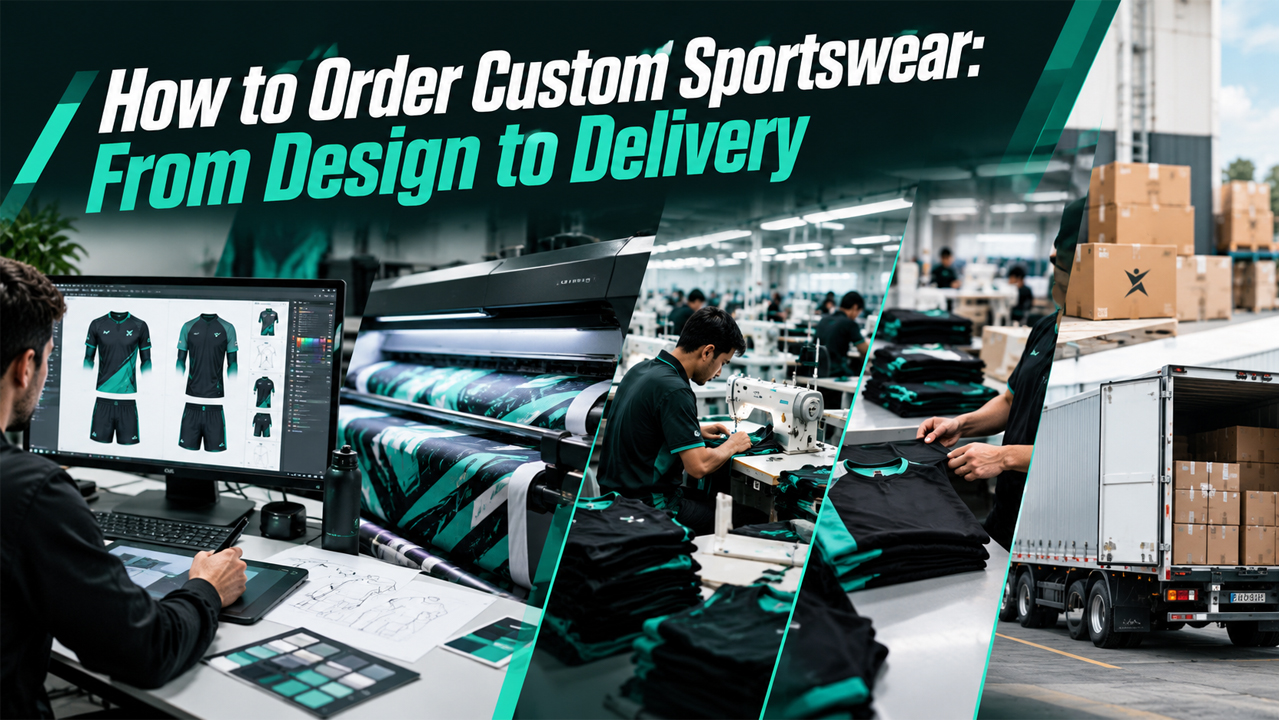
Learn how to order custom sportswear from design and fabric selection to sampling, bulk production, quality control, shipping, and final delivery.
How to Order Custom Sportswear: From Design to Delivery
Learn how to order custom sportswear from design and fabric selection to sampling, bulk production, quality control, shipping, and final delivery.
Ordering custom sportswear is easy to describe but much harder to do correctly.
You have a design. You find a manufacturer. You ask for a price. The factory makes a sample. You approve it. Production starts. The order is shipped.
That sounds straightforward.
But anyone who has actually ordered custom jerseys, team uniforms, activewear, training clothing or private-label sportswear knows there are many smaller decisions between those stages.
What fabric should you use? How many pieces do you need? What is the manufacturer’s MOQ? Does the quoted price include names and numbers? Should the logo be sublimated, embroidered or heat transferred? Does the size chart match your customers? When should the sample be approved? When does the production clock actually start? Who checks the goods before shipment? What happens if the order is delayed?
And perhaps the biggest question: How do you make sure the product you receive is the product you thought you were ordering?
That is what this guide is designed to explain.
Whether you are ordering 20 football kits for a local club, 100 uniforms for a school, 500 garments for a sportswear brand, or a larger private-label collection, the process is based on the same principle: Clear information at the beginning creates fewer problems at the end.
Current manufacturer workflows also show that the process normally moves from the buyer’s requirements and quotation through sample approval, bulk production, quality control and shipping.
So let’s go through the process properly.
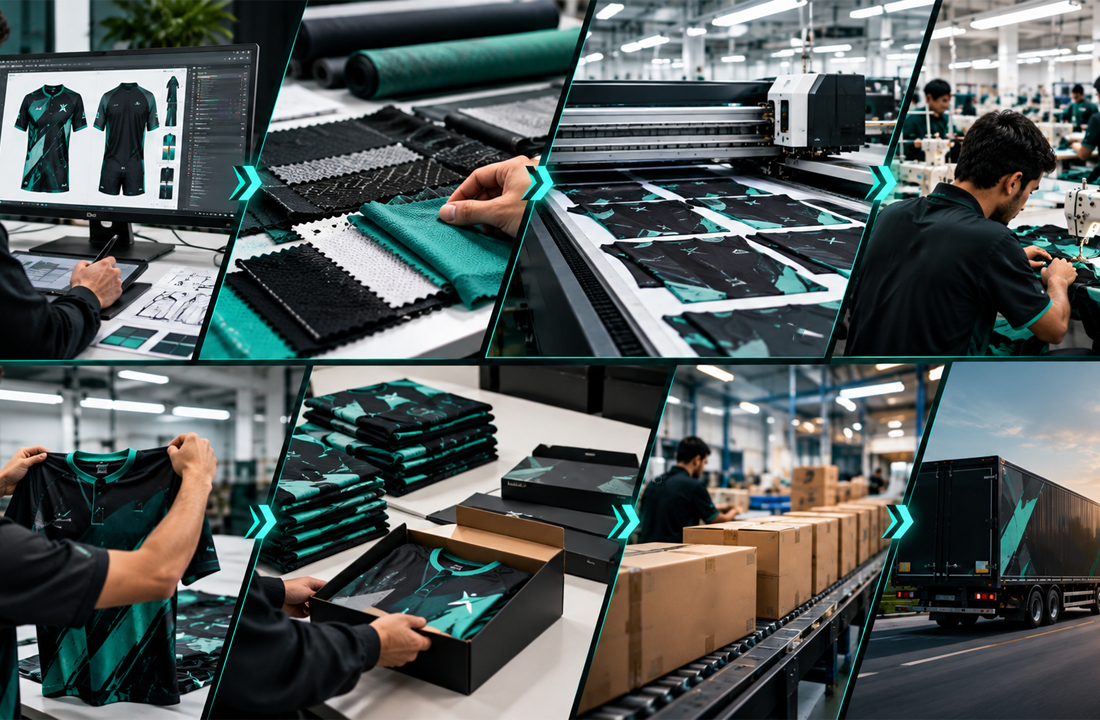
How to Order Custom Sportswear: The Complete Process
The typical Custom Sportswear ordering process looks like this:
- Define the product
- Decide the quantity
- Prepare your design
- Choose fabric and construction
- Find suitable manufacturers
- Request quotations
- Review the quotation
- Order a sample
- Check and revise the sample
- Approve the final specification
- Confirm sizes, names and numbers
- Confirm payment and production
- Monitor bulk production
- Complete quality control
- Pack and ship
- Receive and inspect the order
This process can be shorter for a simple team order and more detailed for private-label or technical sportswear.
Step 1: Decide Exactly What You Want to Order
Before searching for a manufacturer, define your product.
Simply saying “I need custom sportswear” is not enough.
A manufacturer could interpret that as:
- American football uniforms
- Baseball uniforms
- Basketball uniforms
- Cricket kits
- Ice hockey jerseys
- Rugby uniforms
- Tennis uniforms
- Compression wear
- Gym clothing
- Tracksuits
- Hoodies
- Training wear
- MMA clothing
- Cycling apparel
- Running apparel
- Leggings
- Sports bras
- Activewear
- Private-label clothing
Instead, describe the actual product.
For example: “We need 100 custom football jerseys with full sublimation, player names and numbers, polyester performance fabric, and individual packaging.”
That gives the manufacturer something concrete to quote.
Decide Whether You Need a Single Product or a Complete Kit
A team order may include:
- Jersey
- Shorts
- Socks
- Training shirt
- Training shorts
- Tracksuit
- Hoodie
- Jacket
- Polo
- Coach shirt
- Travel wear
A sportswear brand may need an even wider range.
For example:
Collection A: Performance T-shirt, Training shorts, Compression top
Collection B: Hoodie, Joggers, Tracksuit jacket
Collection C: Football jersey, Football shorts, Training top
Planning this before contacting manufacturers makes your quotation much more accurate.
Step 2: Decide Your Quantity and Understand MOQ
Quantity is one of the first things a manufacturer will want to know.
Your quantity can affect: Unit price, Fabric purchasing, Printing setup, Production planning, Packaging, Shipping, MOQ eligibility.
But there is an important point many first-time buyers miss:
MOQ Does Not Always Mean the Same Thing
One manufacturer may say: “MOQ: 20 pieces.”
Another may say: “MOQ: 50 pieces per style.”
Another may calculate MOQ by: Style, Color, Design, Product, Fabric, Complete set.
Current Sialkot manufacturers publish very different MOQ structures, including examples from around 10–50+ units or sets depending on the product and customization.
So never ask only: “What is your MOQ?”
Ask: “Is the MOQ calculated per design, color, style, set or complete order?”
That gives you a much clearer answer.
Step 3: Prepare Your Design
Your design is the starting point for manufacturing.
You do not necessarily need a professional technical designer.
Depending on the manufacturer, you may be able to start with: Sketch, Screenshot, Reference garment, PDF, Photoshop file, Illustrator file, Digital mockup, Tech pack, Existing product sample.
Some manufacturers specifically state that they can work from a tech pack, reference image, drawing or physical sample.
Your Design Should Clearly Show
At minimum:
- Front
- Back
- Side if necessary
- Main colors
- Secondary colors
- Logo position
- Sponsor position
- Number position
- Player-name position
- Collar
- Sleeves
- Shorts
- Special panels
- Patterns
- Branding
If you have a specific brand color, provide an exact reference instead of simply saying: “Make it blue.”
A defined color reference reduces interpretation during production.
Step 4: Create a Proper Production Brief
This is where a professional buyer separates themselves from a casual buyer.
Instead of sending random information through WhatsApp over several days, prepare one production brief.
Example Production Brief
- Product: Custom football jersey
- Quantity: 200 pieces
- Fabric: Performance polyester
- Construction: Athletic fit
- Decoration: Full sublimation
- Logo: Left chest
- Sponsor: Center chest
- Player name: Upper back
- Player number: Back and shorts
- Sizes: XS–3XL
- Labels: Custom woven neck label
- Packaging: Individual polybag
- Destination: United Kingdom
- Required delivery: 20 November
This gives the manufacturer a much better foundation for a quotation.
Step 5: Understand the Difference Between a Mockup and a Tech Pack
This is an important distinction.
A mockup mainly shows appearance.
A tech pack explains production requirements.
A mockup might tell the factory: “This is what the jersey should look like.”
A tech pack can tell the factory: “This is how the jersey should be constructed.”
A detailed specification can include: Fabric composition, GSM, Measurements, Size grading, Seam construction, Stitching, Collar construction, Sleeve construction, Hem, Artwork, Logo dimensions, Print locations, Label placement, Packaging, Washing instructions.
If you are ordering a simple team jersey, you may not need a highly technical document.
If you are launching a serious sportswear brand, however, a detailed tech pack can make future production much easier.
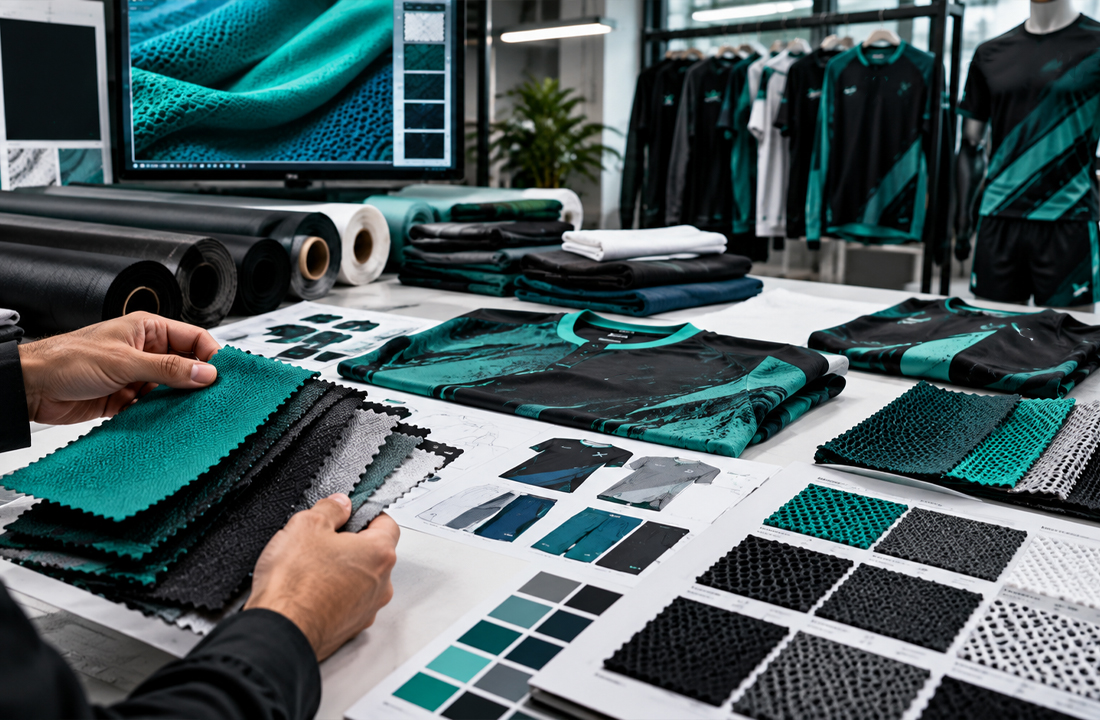
Step 6: Choose the Right Fabric
Fabric should be selected according to the product’s purpose.
A football jersey has different requirements from: Compression leggings, Basketball shorts, Training jackets, Hoodies, Tracksuits, Fight shorts.
Common sportswear materials include:
Polyester
Frequently used for team jerseys and performance garments.
Polyester Mesh
Useful when ventilation is an important part of the design.
Polyester-Spandex
Useful for garments that need stretch and recovery.
Nylon Blends
Can be suitable for specific performance garments where durability and stretch are required.
Cotton Blends
Often useful for lifestyle or casual sportswear where softness is important.
The correct choice depends on the garment.
Step 7: Ask About GSM — But Don’t Judge Fabric by GSM Alone
GSM means grams per square meter.
It gives you an indication of fabric weight.
But heavier does not automatically mean better.
For example, a lightweight football jersey may be more comfortable in hot conditions. A heavier hoodie may be better for colder weather. A compression garment may need a specific combination of weight, stretch and recovery.
So instead of asking: “Give me your highest GSM.”
Ask: “Which fabric construction and GSM would you recommend for this particular product and use?”
That creates a much better technical discussion.
Step 8: Choose the Right Customization Method
Your artwork needs to be applied to the garment somehow.
Common methods include: Sublimation, Screen printing, Heat transfer, DTF, Embroidery, Woven patches, Silicone badges, Rubber patches, Heat-transfer names and numbers.
The right method depends on: Fabric, Artwork, Quantity, Detail, Durability, Garment construction, Budget.
Sublimation for Sports Jerseys
Sublimation is particularly common for polyester sports garments.
It can be used for complex designs covering large areas of a garment.
This is why it is frequently associated with custom football, basketball, volleyball and other team jerseys.
Embroidery
Embroidery can be suitable for: Jackets, Hoodies, Caps, Polos, Lifestyle products, Certain logos.
But embroidery is not automatically suitable for every performance garment.
A heavy embroidered logo can change the feel and flexibility of a lightweight garment.
Heat Transfer
Heat transfer can be useful for: Names, Numbers, Small logos, Personalized team garments.
Your manufacturer should recommend the most suitable method for the actual garment rather than using the same method for everything.
Step 9: Find the Right Custom Sportswear Manufacturer
Finding a manufacturer is not simply a Google search exercise.
You need to find a manufacturer whose production capabilities match your requirements.
For example, if you need: Full sublimation, Private labels, Custom packaging, 20-piece MOQ, Individual player names, Worldwide shipping — then your supplier needs to support those requirements.
Questions to Ask Before Ordering
- What products do you manufacture?
- What is the MOQ?
- How is MOQ calculated?
- Do you make samples?
- How long does sampling take?
- How long does production take?
- What fabrics are available?
- Can you work from my design?
- Can you make private labels?
- Can you produce custom packaging?
- How are names and numbers handled?
- Where does production take place?
- Is production in-house or outsourced?
- What quality-control system do you use?
- What shipping options are available?
These questions can reveal a lot about the supplier.
Step 10: Check Whether the Manufacturer Is Actually a Factory
This matters more than many buyers realize.
Some businesses manufacture products themselves.
Others coordinate production through third-party factories.
Neither model is automatically suitable or unsuitable.
But you should know which model you are dealing with.
Ask: “Which parts of production are done in-house?”
For example: Cutting, Sewing, Sublimation, Embroidery, Printing, Finishing, QC, Packing.
Some current Sialkot manufacturers explicitly advertise in-house production across several of these stages, while others describe their services differently.
You should understand what your supplier actually controls.
Step 11: Request a Detailed Quotation
Once the manufacturer understands your requirements, request a complete quotation.
A quotation should ideally identify: Product, Quantity, Fabric, Decoration, Branding, Labels, Packaging, Sample cost, Unit price, Production time, Shipping, Payment terms.
Do not compare suppliers based only on one number.
For example:
Supplier A
$12 per jersey
Supplier B
$10 per jersey
At first glance, Supplier B appears cheaper.
But what if Supplier A includes names, includes numbers, includes packaging, includes sample — while Supplier B charges these separately?
The comparison changes.
Step 12: Order a Physical Sample
A physical sample is one of the most useful checkpoints in the entire Custom Sportswear process.
A digital image cannot tell you everything.
A physical sample lets you inspect: Fabric, Fit, Stitching, Color, Printing, Logo, Collar, Sleeves, Finishing, Overall construction.
Current manufacturing workflows commonly place sample approval before bulk cutting or production.
That is important because changing one sample is much easier than changing an entire production run.
Step 13: Test the Sample Properly
Do not simply look at the sample and say: “Looks good.”
Check it.
Fit Check
Measure: Chest, Length, Shoulder, Sleeve, Waist, Short length.
Compare the garment against the agreed measurement chart.
Fabric Check
Ask: Does it feel right? Is it too thin? Is it too heavy? Does it stretch correctly? Is the surface suitable for the sport?
Artwork Check
Look at: Color, Logo, Sponsor, Pattern, Name, Number, Position.
Construction Check
Look at: Seams, Stitching, Collar, Sleeve, Hem, Loose threads, Finishing.
Do not approve the sample simply because the artwork looks attractive.
Approve it because the garment meets the agreed specification.
Step 14: Give Clear Sample Feedback
If the sample needs changes, do not send a message like: “Please improve the shirt.”
That is too vague.
Instead: “Increase body length by 2 cm.” “Move the sponsor logo 1 cm lower.” “Change the blue to the approved color reference.” “Reduce sleeve opening by 1.5 cm.” “Change the neck label to the supplied artwork.”
Specific feedback is easier for a production team to understand.
Step 15: Approve the Final Sample
Once the sample is correct, formally approve it.
Your approved sample should become the production reference.
Keep photographs of: Front, Back, Side, Labels, Logo, Fabric, Important details.
Also keep the final artwork and measurement chart.
This creates a record of exactly what you approved.
Step 16: Confirm the Size Breakdown
For team orders, size management is critical.
Do not send: “50 mixed sizes.”
Prepare a clear list.
| Player | Jersey | Shorts | Name | Number |
|---|---|---|---|---|
| Ahmed | M | M | AHMED | 7 |
| Bilal | L | L | BILAL | 10 |
| Hamza | M | M | HAMZA | 14 |
| Usman | XL | XL | USMAN | 21 |
This can also be used for: Schools, Academies, Clubs, Leagues, Corporate teams.
Step 17: Check Names and Numbers Twice
Names and numbers are easy to overlook.
But one incorrect name can make an otherwise perfect garment unusable for the intended player.
Check: Spelling, Number, Size, Player, Product, Front/back placement.
Have another person verify the list before production begins.
This is a small administrative step that can prevent a surprisingly expensive mistake.
Step 18: Confirm Payment Terms
Payment terms vary between manufacturers.
You may encounter: Deposit + balance, Full payment for smaller orders, Sample payment separately, Different terms for repeat buyers.
Do not make assumptions.
Confirm everything in writing.
Confirm:
- Total order value
- Deposit
- Balance
- Payment method
- Production start condition
- Final payment condition
For an international order, keep the quotation, invoice and payment records together.
Step 19: Understand When the Production Clock Starts
This is one of the most important questions you can ask.
Suppose a manufacturer says: “Production takes 20 working days.”
Ask: “When does those 20 working days begin?”
Is it after: First inquiry? Artwork approval? Sample approval? Deposit? Final size confirmation? Fabric availability?
Different factories define production lead time differently.
Current manufacturer pages demonstrate substantial differences in advertised sampling and production timelines, so buyers should confirm the timeline for the exact order rather than assume one industry-wide figure.
Step 20: Calculate the Full Lead Time
Do not calculate only bulk production.
Your project may involve:
- Design → 2–5 days
- Sampling → several working days
- Sample revision → additional time if necessary
- Production → depends on order
- QC and packing → additional processing
- Shipping → depends on destination and service
- Customs → depends on country and shipment
Your real project timeline is therefore: Development + Sampling + Production + Shipping + Customs
That is the number you should use when planning a tournament, product launch or retail release.
Step 21: Give Your Manufacturer a Real Delivery Date
Don’t say: “I need it quickly.”
Give a specific date.
For example: “The products must arrive in Germany by 10 November.”
Then ask the manufacturer to confirm whether that schedule is realistic.
Also leave some buffer.
If your tournament starts on Saturday, receiving the uniforms Friday evening is risky.
A delayed flight, customs issue or local courier problem could leave you with no practical solution.
Step 22: Understand International Shipping
After production, the order needs to move from the factory to you.
Possible options include:
Express Courier
Useful for smaller and urgent shipments.
Air Freight
Useful for larger shipments where speed remains important.
Sea Freight
Often considered for larger shipments where transit time is less critical.
The best option depends on: Weight, Carton size, Quantity, Destination, Deadline, Budget.
Some current Sialkot manufacturers advertise worldwide shipment through major courier services, while exact transit times vary by destination and shipment.
Step 23: Understand Customs and Import Charges
Shipping and customs are not always the same thing.
Ask your manufacturer: Is shipping door-to-door? Is customs clearance included? Are duties included? Are taxes included? Who handles import documentation? Will I receive tracking? What documents come with the shipment?
Never assume that “shipping included” means all possible import costs are included.
Step 24: Quality Control Before Shipment
Before the goods leave the factory, they should be checked.
For a teamwear order, QC should cover: Quantity, Sizes, Colors, Logos, Names, Numbers, Stitching, Printing, Labels, Packaging, Visible defects.
Current teamwear manufacturing processes commonly describe checks covering measurements, stitching, artwork, finishing and final inspection before dispatch.
For larger orders, ask whether the manufacturer can provide: QC photographs, Inspection reports, Production photographs, Carton information.
Step 25: Keep a Complete Production File
Once your order is complete, don’t throw away the documents.
Keep: Final artwork, Tech pack, Approved sample photos, Fabric details, Size chart, Player list, Quotation, Invoice, Payment record, QC photos, Shipping documents, Tracking information.
This becomes extremely useful when you reorder.
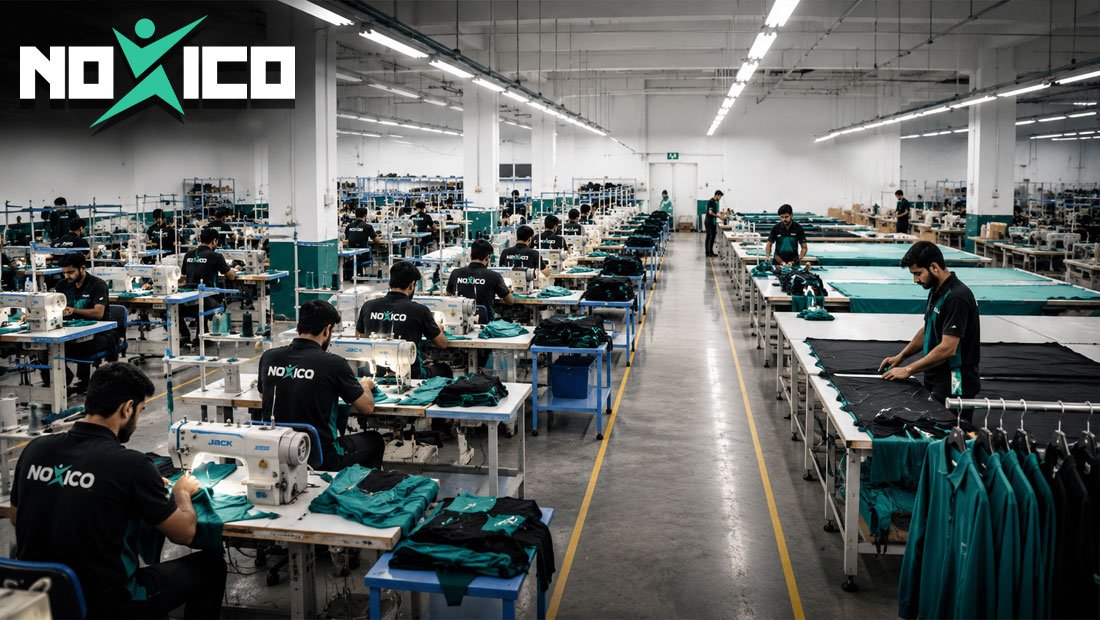
How to Order Custom Sportswear for a Football Team
A football club typically needs: Match jersey, Match shorts, Player names, Player numbers, Goalkeeper kit, Multiple sizes, Club logo, Sponsor logo.
The easiest system is a master player spreadsheet.
| Player | Jersey | Shorts | Name | Number |
|---|---|---|---|---|
| Player 1 | S | S | PLAYER 1 | 4 |
| Player 2 | M | M | PLAYER 2 | 8 |
| Player 3 | L | L | PLAYER 3 | 11 |
Send the same final spreadsheet to the manufacturer.
Don’t keep changing it through separate WhatsApp messages.
How to Order Custom Sportswear for a School
Schools may have different requirements.
For example: Junior sizes, Senior sizes, Multiple teams, Different sports, House colors, Student names, Coaches’ uniforms.
Create separate sections for: Sport, Age group, Product, Size, Quantity.
This makes a large school order easier to manage.
How to Order Custom Sportswear for a Sportswear Brand
If you are launching your own brand, the process becomes more detailed.
You may need: Main garment, Brand label, Size label, Hang tag, Care label, Packaging, Barcode, Product SKU, Custom polybag, Carton marking.
You should also ask: “Can you reproduce this exact product for future orders?”
That question matters because your first sample may be excellent, but your business needs consistent reorders.
How to Order Private Label Sportswear
Private-label sportswear means the manufacturer produces the garments under your brand identity.
You may need: Neck labels, Woven labels, Hang tags, Care labels, Packaging, Brand colors, Custom product specifications.
Many current Sialkot manufacturers advertise OEM/private-label services alongside teamwear production.
Before placing the order, confirm exactly what private-label services are included.
How to Order Custom Sportswear From Pakistan
Pakistan has a major sports-goods manufacturing ecosystem, and Sialkot is particularly prominent in sports manufacturing.
If you are considering a Sialkot supplier, don’t choose purely because the manufacturer is located in Pakistan.
Evaluate the actual supplier.
Ask: What do you manufacture? Where is production performed? Do you have your own production floor? Which processes are in-house? What are your MOQ terms? Can you provide samples? How do you manage QC? How do you handle international shipping?
The location is only one part of the supplier evaluation.
Why Sialkot Is Relevant to Custom Sportswear Buyers
Sialkot-based manufacturers currently advertise capabilities covering: Teamwear, Football, Basketball, Cricket, Activewear, Compression wear, Fightwear, Private label, OEM, Custom packaging.
The exact capability differs by company, so buyers should evaluate the individual manufacturer rather than assume every supplier offers the same service.
Real Example: Ordering 50 Custom Football Kits
Let’s say a football club needs: 50 jerseys, 50 shorts, Mixed sizes, Club logo, Sponsor logo, Player names, Player numbers, Two main colors, Full sublimation, Delivery to the UK.
Instead of sending: “Can you make 50 kits?”
Send: “We need 50 complete football kits consisting of sublimated polyester jerseys and matching shorts. The design is attached. We require player names and numbers, mixed sizes from S to 3XL, club and sponsor branding, individual packaging and delivery to the UK. Please quote MOQ, sample cost, unit price, production time, shipping and payment terms.”
Now the manufacturer has enough information to start a meaningful discussion.
What a Good Quotation Should Look Like
A useful quotation might look like:
| Requirement | Details |
|---|---|
| Product | Football jersey |
| Quantity | 100 pcs |
| Fabric | Polyester |
| Decoration | Sublimation |
| Logo | Included |
| Names | Included |
| Numbers | Included |
| Label | Custom |
| Packaging | Individual |
| Sample | Available |
| MOQ | Confirmed |
| Production | Confirmed |
| Shipping | Separate/Included |
| Payment | Confirmed |
The exact commercial terms will depend on the manufacturer.
The important thing is that both sides understand what the price represents.
What If the Manufacturer’s Price Is Too High?
Don’t immediately say: “Give me a cheaper price.”
First identify what is making the product expensive.
Possible factors include: Fabric, Quantity, Construction, Printing, Embroidery, Packaging, Labels, Special trims, Low order volume, Shipping.
Then ask: “What changes could reduce the cost without significantly changing the product?”
That creates a more productive conversation.
How to Compare Custom Sportswear Suppliers
Never compare only unit price.
Compare:
Product
Is the same garment being quoted?
Fabric
Is the fabric specification equivalent?
Customization
Are the same logos, names and numbers included?
Sample
Is a physical sample included?
MOQ
Are you comparing the same quantity?
Production
Are the lead times comparable?
Packaging
Is packaging included?
Shipping
Are both quotes based on the same shipping terms?
Quality control
What happens before dispatch?
Only after these points are aligned does a price comparison become meaningful.
Common Custom Sportswear Ordering Mistakes
1. Asking for a Price Without a Quantity
A manufacturer needs quantity to calculate the order properly.
2. Sending Only a Screenshot
A screenshot does not necessarily explain fabric, measurements or construction.
3. Not Asking About MOQ
A low unit price is irrelevant if the supplier’s minimum is far above your required quantity.
4. Choosing Fabric Without Understanding Its Use
Different sports require different garment characteristics.
5. Skipping the Sample
This creates unnecessary production risk.
6. Approving the Sample Too Quickly
Check fit, fabric, artwork and construction.
7. Sending Names and Numbers at the Last Minute
This creates avoidable administrative pressure.
8. Changing the Design After Production Starts
Late changes can cause additional cost and delays.
9. Planning Only for Manufacturing
Shipping and customs also require time.
10. Choosing Only on Price
Always compare equivalent specifications.
How to Avoid Custom Sportswear Production Problems
The best way to prevent problems is to make important decisions before production starts.
Before approving bulk production, confirm:
- Product
- Fabric
- Color
- Artwork
- Measurements
- Customization
- Labels
- Packaging
- Quantity
- Sizes
- Names
- Numbers
- Delivery date
- Shipping method
- Payment terms
If all of these are documented, there is much less room for misunderstanding.
How Long Does Custom Sportswear Take?
There is no single answer.
Different products and manufacturers have different timelines.
For example, current Sialkot manufacturers advertise sample development anywhere from roughly a week to several weeks and bulk production anywhere from around 10–30 working days or more, depending on the program.
The important thing is not to copy a generic timeline from a website.
Ask: “What is the estimated timeline for my exact product, quantity, destination and customization?”
Then confirm when the timeline begins.
How to Reduce Your Production Lead Time
You can often save time by preparing everything before contacting the manufacturer.
Have ready: Final artwork, Logo files, Color references, Quantity, Size breakdown, Names, Numbers, Fabric preference, Packaging requirements, Delivery destination, Required date.
Then respond quickly to sample revisions and production questions.
A manufacturer cannot move forward while waiting for buyer approval.
What to Do When Your Order Arrives
When the cartons arrive, inspect them.
Check: Carton count, Product quantity, Sizes, Colors, Logos, Names, Numbers, Stitching, Printing, Packaging.
For a team order, compare the products against the original player list.
If something is wrong, take photographs immediately.
Keep the shipping packaging and documentation until the order has been fully checked.
The Second Order Should Be Easier Than the First
Your first order creates valuable production information.
Save it.
Your second order should use: Same approved artwork, Same fabric specification, Same measurement chart, Same label, Same packaging, Same player-list format.
This reduces unnecessary development work.
For a growing sportswear brand, maintaining these records can become part of your standard production system.
Custom Sportswear Ordering Checklist
Before placing your order, ask yourself:
Product
What exactly am I ordering?
Quantity
How many pieces do I need?
MOQ
Does the manufacturer’s MOQ match my order?
Design
Is my artwork complete?
Fabric
Have I selected the correct fabric?
GSM
Have I discussed the fabric weight?
Branding
Are logos and artwork finalized?
Customization
Are names and numbers required?
Sizes
Do I have the complete size breakdown?
Sample
Will I receive a physical sample?
Approval
Have I checked and approved the sample?
Production
When does production officially begin?
Quality
How will the order be inspected?
Packaging
How should each product be packed?
Shipping
Which shipping method will be used?
Customs
Who handles import clearance?
Deadline
Is there enough buffer before my event or launch?
If you can answer these questions, you are in a much stronger position to place your order.
Frequently Asked Questions About Ordering Custom Sportswear
How do I order custom sportswear?
Start by defining the product, quantity, design, fabric and customization requirements. Send those details to a suitable manufacturer, request a quotation, order a sample, approve the final specification and then confirm bulk production and shipping.
What information does a custom sportswear manufacturer need?
Usually, the manufacturer needs the product type, quantity, design or reference, fabric preference, branding requirements, size range and destination. More detailed information generally makes quotation and development easier.
Do I need a tech pack?
Not always. A manufacturer may be able to work from a reference image, mockup or physical sample. However, a detailed tech pack can be valuable for technical products and repeat production.
What is the MOQ for custom sportswear?
There is no universal MOQ. Current manufacturers publish different minimums depending on product, design, color, fabric and decoration. Some advertise low minimums for teamwear, while other products require higher quantities.
Should I order a sample before bulk production?
For a new manufacturer or new product, a physical sample is a valuable checkpoint. It allows you to check fit, fabric, construction, artwork and branding before committing to the full production run.
How long does custom sportswear production take?
It depends on the manufacturer, product, quantity and complexity. Sampling and bulk production should be treated as separate stages, and shipping must also be included when calculating the total delivery time.
Can I order different sizes in the same design?
Many teamwear manufacturers allow mixed sizes within the same design, but the exact arrangement depends on the supplier’s MOQ and production rules.
Can player names and numbers be added?
Yes, many custom teamwear manufacturers support individual names and numbers. Provide the final player list in a clear spreadsheet and approve it before production.
Can a manufacturer make my existing design?
Often yes. Manufacturers may work from artwork, mockups, tech packs, reference garments or other specifications.
Can I order custom sportswear from Pakistan?
Yes. Sialkot has a large sports manufacturing ecosystem, and current Sialkot manufacturers advertise custom teamwear, activewear, private-label and OEM production for international buyers.
Is the cheapest manufacturer always the best option?
Price should be compared together with product specifications, MOQ, sample process, customization, quality control, packaging, production time and shipping terms.
Final Thoughts: Get the Details Right Before Production
Ordering Custom Sportswear does not have to be complicated.
But it does need to be organized.
Start with a clear product requirement. Prepare the design. Confirm quantity and MOQ. Choose the fabric carefully. Discuss customization. Compare manufacturers based on equivalent specifications. Request a sample. Check the sample properly. Approve the final production reference. Confirm every size, name and number. Then move into bulk production.
Finally, plan QC, packing, shipping and customs before the order leaves the factory.
The biggest lesson is simple: Do not expect the manufacturer to guess what you mean.
The clearer your requirements are, the easier it becomes for the manufacturer to quote, sample, produce and ship the right product.
Whether you are a football club ordering 20 kits, a school ordering 100 uniforms, a distributor ordering 1,000 pieces, or a new brand developing its first collection, the same principle applies: Define it clearly. Sample it properly. Approve it carefully. Then produce it.
That is how you move from a design on a screen to finished Custom Sportswear in your hands.
Ready to Order Custom Sportswear?
If you already have a design, the next step is simple.
Prepare your: Design, Quantity, Fabric preference, Size range, Logo files, Customization requirements, Delivery country, Required delivery date.
Then send the complete brief to your chosen manufacturer and request a detailed quotation.
A professional manufacturer should be able to tell you what is possible, what information is missing, what the sample process involves, and what the expected production and delivery timeline looks like.
The goal is not simply to place an order.
The goal is to build a product that matches your approved design, fits the intended users, meets the required quality level and arrives when you need it.
Ready to Order Your Custom Sportswear?
Get a free, no-obligation quote from Noxico International today.
Get a Free Quote